PURCHASE REQUISITION SOFTWARE
Purchase requisition software that turns a need into an accountable buying request.
Purchase requisition software structures the internal request that comes before sourcing or a purchase order: what is needed, why, where, when, by whom and under which approval context.
THE OPERATING PROBLEM
Keep context with the decision.
A one-line chat request leaves procurement to rediscover specifications, quantity, delivery location, business purpose and urgency. Each handoff adds delay and makes the later purchase file weaker.
WHO IT IS FOR
- Employees and managers who raise operational needs
- Procurement teams that repeatedly chase missing request details
- Branches, clinics, campuses and sites with central buying support
CONNECTED WORKFLOW
From the request to evidence a reviewer can follow.
Describe
Capture requirement lines, purpose, need-by date, location and source attachments.
Review
Present the business and budget context in an approval brief.
Approve
Record authority before sourcing or supplier commitment.
Source
Reuse the accepted requirement in the RFQ and later evidence chain.
REALISTIC EXAMPLE
One purchase, end to end.
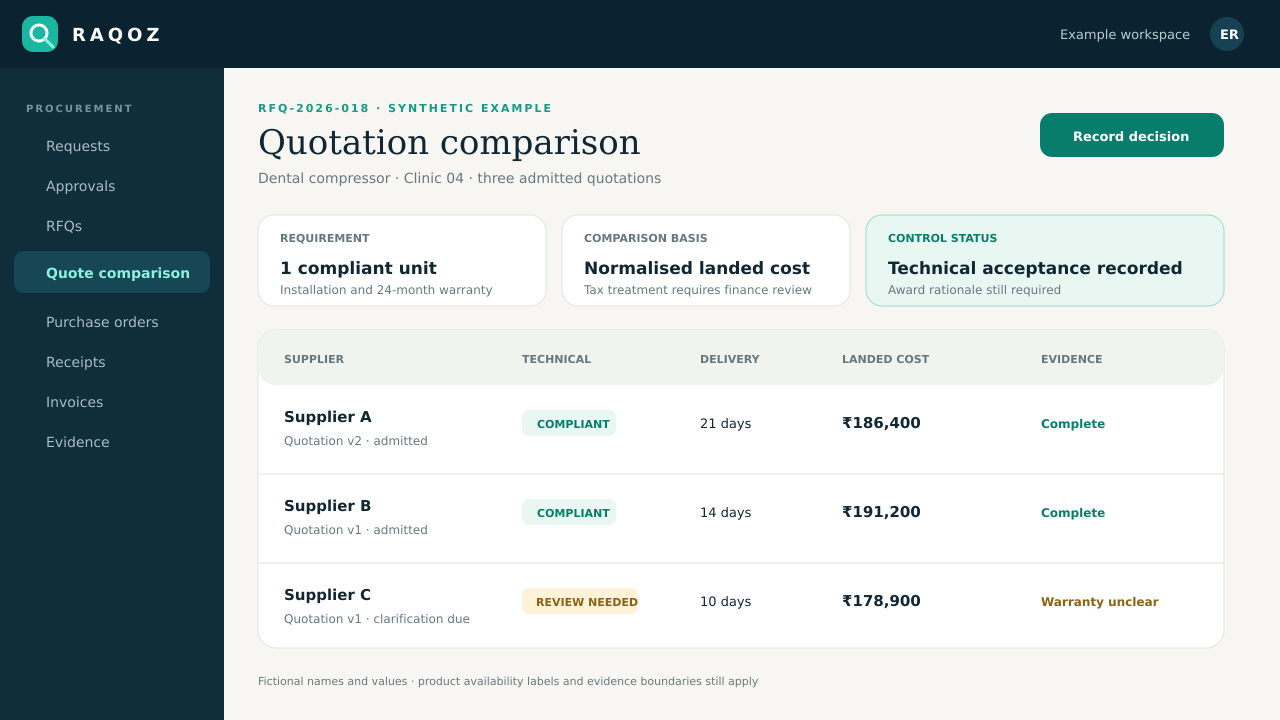
A dental clinic requests a compressor with capacity, installation and need-by details. Central operations can understand the need, approve the right value band and send procurement a sourcing-ready requirement instead of a message that needs interpretation.
What RAQOZ does not replace
A requisition is not a supplier order, accounting entry, construction BOQ or clinical specification approval.
Start with one bounded scope
- Choose the minimum fields an approver genuinely needs.
- Make specifications attachable without asking ordinary employees to write an RFQ.
- Measure how many requests return for clarification during the first month.
Move from Excel, email and WhatsApp
- Choose one department, location or recurring purchase type; do not migrate every historic spreadsheet on day one.
- Import the supplier and item records that are still active, then assign an owner to duplicates and missing fields.
- Keep old email, WhatsApp and spreadsheet files as source evidence while new purchases begin in the controlled workflow.
- Define who requests, approves, sources, receives and reviews invoices before switching the first live purchase.
Security and evidence boundaries
- Organisation data and procurement records remain tenant-scoped; public-site analytics never receives supplier names, prices, documents or purchase records.
- Material workflow actions retain actor and timestamp evidence, while corrections create new evidence instead of silently rewriting history.
- RAQOZ records procurement decisions and payment states. It does not move money, replace the accounting ledger, certify compliance or issue audit, tax or legal conclusions.
USEFUL NEXT STEPS
Use the workflow before buying it.
BUYER QUESTIONS
Questions worth answering before rollout.
What is the difference between a requisition and a purchase order?
A requisition asks the organisation for authority to buy. A purchase order communicates an authorised order to the selected supplier.
Should a requester name a supplier?
A requester may suggest one, but the sourcing method and supplier decision should follow the organisation's policy.
Can attachments be part of the request?
Yes. The workflow supports source-linked request evidence; private procurement documents remain organisation-scoped.
Should every purchase start with a requisition?
The policy may define direct or emergency routes, but the need, authority and exception should still be attributable.
ONE PRIMARY ACTION
Prove the workflow with one real purchase.
Start with one department or location. Preserve the old evidence, define the owners and learn before widening the rollout.
Start with one requisition